You close your laptop after the podcast interview feeling hopeful. The conversation flowed. The host asked thoughtful questions. Listeners were commenting, sending DMs, thanking you for sharing your story. Before signing off, the host says exactly what you'd hoped to hear: "Tell everyone where they can find you." You share your website, and you smile, because you know people are going to click.
The next morning, you open your analytics. The traffic is there. Hundreds of new visitors. You can almost feel the momentum building. Then you log into your email platform, refresh, and see a few new subscribers. Refresh again. Maybe one or two more. That's it.
You stare at the numbers wondering what happened. "I thought that interview went so well. Maybe I just need to get on more podcasts. Maybe I need more traffic."
It's the conclusion most business owners reach, and it's usually the wrong one. Because the problem often isn't getting people to your website. The problem is what happens after they arrive.
After years of helping women entrepreneurs grow their visibility through collaborations, podcast interviews, virtual summits, bundles, and strategic partnerships, I've noticed something. The women who build sustainable businesses aren't always the ones getting the most traffic. They're the ones who have a clear system for turning attention into relationships.
I love collaborations. I teach them. They let you borrow trust from someone who has already built an engaged audience. When you're invited onto a podcast or asked to speak at a summit, people pay attention because someone they already know has essentially said, "You should listen to her." That's powerful.
But visibility has a job, and its job isn't to make the sale. Its job is to begin the relationship. Your website's job is to continue it. Too often, entrepreneurs work tirelessly to earn attention only to lose it within seconds, because their website doesn't give visitors a reason to stay.
So we've been asking the wrong question. Instead of "How do I get more traffic?" we should be asking "What experience are people having once they arrive?" Traffic is only the invitation. Your system determines what happens next. If your website isn't designed to move people from curious visitor to engaged subscriber, more traffic won't solve your problem. It will simply expose it faster.
The Traffic Myth Most
Business Owners Believe
There's a belief that quietly drives much of online marketing: more traffic equals more subscribers equals more sales equals business growth. Sometimes that's true, but only when the middle of that equation actually works.
Imagine pouring water into a bucket with holes in the bottom. Would adding more water solve the problem? Of course not. The bucket would still leak, and you'd simply waste more water. Your website works the same way. If visitors land on your homepage and leave without taking the next step, adding more traffic doesn't fix the leak. It just sends more people through a system that isn't serving them well.
That's why I encourage clients to stop obsessing over page views and start paying attention to what happens after someone arrives. Ask yourself: Can a first-time visitor tell who I help within a few seconds? Is it immediately obvious what problem I solve? Do visitors know what to do next? Is there a compelling reason to join my email list? Does my website continue the conversation they were already having with me?
One of the core beliefs behind my Revenue Without Drama™ philosophy is this:
Traffic doesn't create relationships. Systems do.
Traffic gets people to your front door. Your system is what invites them inside.
Why Collaborations Don't
Automatically Grow Your Audience
If you've ever heard me teach about visibility, you know I'm a huge advocate for collaborations. Podcast interviews, virtual summits, bundle giveaways, guest trainings, newsletter swaps, speaking opportunities. They're one of the fastest ways to get in front of warm, aligned audiences without relying solely on social media algorithms.
But here's where people get stuck. They assume the collaboration itself is responsible for growing their email list. It isn't. The collaboration creates attention. Your website determines whether that attention becomes a relationship.
That's why two people can join the exact same summit and walk away with completely different results. One speaker gains hundreds of engaged subscribers. Another gains only a handful. The difference usually isn't the summit, the podcast, or the audience. It's what happened after someone clicked.
Think about it from your visitor's perspective. They heard you speak about your topic and connected with it. They liked your story. They trusted your expertise enough to click the link in the show notes. That click is an act of trust, and now your website has one job: confirm they made the right decision.
Instead, many websites unintentionally interrupt the conversation. A listener hears you talk about building confidence in business, then lands on a homepage that feels generic. A summit attendee loves your teaching, but your featured freebie has nothing to do with the topic you just presented. Someone is excited to learn more, then finds five different calls to action competing for their attention.
The problem isn't the traffic. The problem is the lack of alignment. And people don't subscribe simply because you got their attention. They subscribe because you kept it.
The Alignment Chain™:
Where Most Businesses Lose Subscribers
When someone hears you on a podcast, watches your summit presentation, or discovers you through a referral, they're already forming an opinion. They're thinking, "She understands what I'm struggling with. I like how she explains things. I want to learn more." Then they click.
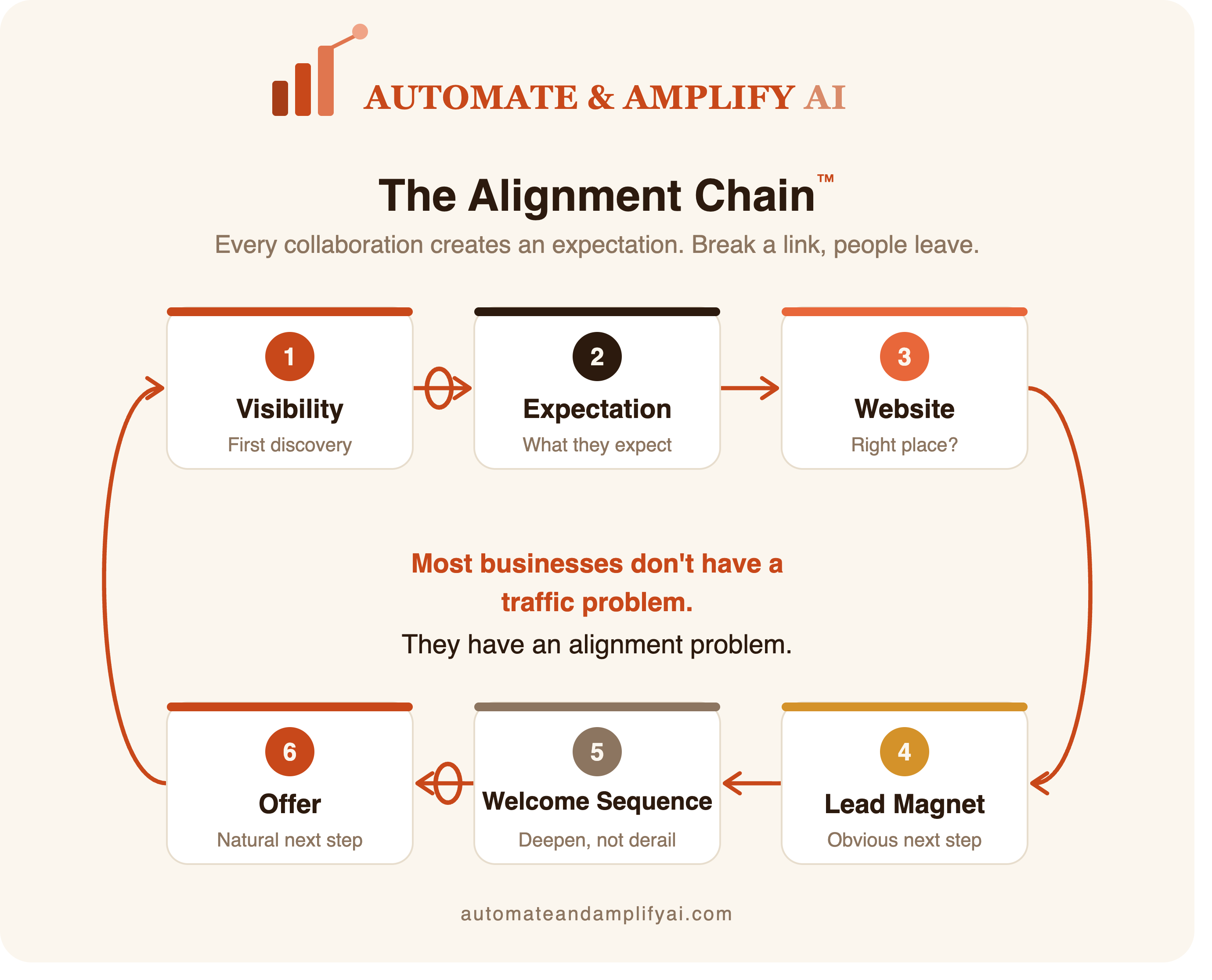
I call the path that follows The Alignment Chain™. Every step should feel like the natural continuation of the one before it:
When this chain stays connected, visitors move naturally from browser to subscriber, and eventually from subscriber to buyer. When one link breaks, people leave. Not because your content wasn't good, but because something along the journey created uncertainty. That's why I believe most businesses don't have a traffic problem. They have an alignment problem.
Picture it in action. You're invited to speak on a podcast about becoming more visible in your business. You share your story, you teach practical strategies, listeners connect with you, and the host sends everyone to your website. Perfect. Now imagine your homepage says, "Helping entrepreneurs scale to six figures through operational excellence." There's nothing wrong with that message, but it isn't the conversation your new visitor expected to continue. Every disconnect creates friction, and every point of friction makes it easier for someone to leave. The goal isn't to create more content. The goal is to create continuity.
They Just Aren't That Into You...
Or Are They?
When someone visits your website and leaves without subscribing, it's easy to assume, "I guess they just weren't that into me." Sometimes that's true. Not everyone who visits is your ideal client, and that's okay. But more often, they didn't leave because they disliked you. They left because something in the experience created uncertainty. Here are the four most common reasons.
The Next Right Step™
Principle
One of the simplest ways to improve your website is to embrace what I call The Next Right Step™ Principle. Every visitor should immediately know the answer to one question: "What's my next step?" Not five steps. Not ten. One.
If someone discovered you through a podcast interview, what do you want them to do next? If they came from a summit, where should they go? Maybe it's downloading a guide, joining your email list through a valuable resource, or taking a quiz. Whatever it is, make it obvious. Every extra decision creates friction, and every unnecessary click increases the chance they'll leave. The best websites don't overwhelm visitors with possibilities. They confidently guide them toward one meaningful action. That's what turns browsers into subscribers.
A Real-World
Example
One of my clients recently completed my Collabs Without Guesswork Audit because she wanted an objective look at her business before investing more time in visibility. Like many entrepreneurs, she assumed she had most things covered and simply wanted to spot the gaps she couldn't see on her own.
The audit uncovered several opportunities she hadn't noticed, including broken links, unclear messaging, and places where her website could do a better job guiding visitors to join her directory. As she worked through the recommendations, she cleaned up outdated pages, pointed links directly to her current offers, and simplified the parts of her website creating unnecessary friction.
When I asked how she felt afterward, her answer was simple: "Much better." Then she said something that captures why this work matters: "Before the audit, I knew I had some issues but was unsure which ones. Now I realize I have easy fixes for those areas and confirmation of my plan going forward." Sometimes the biggest breakthrough isn't getting more visibility. It's making better use of the visibility you've already earned. Once your website is aligned, every future collaboration becomes more valuable.
More Traffic
Magnifies Your Problems
Let's go back to where we started. You landed the collaboration, people clicked, and your analytics proved it, but your email list barely moved. Your first instinct was probably, "I need more traffic." Before you spend another week pitching podcasts or applying to speak, ask yourself one question: What happened to the people who already visited my website?
Here's why that matters. Imagine your website converts 1% of visitors into subscribers. This month, 500 people visit and 5 join your list. Now you're featured on a large podcast, and suddenly 10,000 people visit. You expect your list to explode. Instead, only 100 people subscribe, and the other 9,900 leave.
The podcast wasn't the problem. The summit wasn't the problem. Your visibility wasn't the problem. Your website simply did what it has always done. It converted about 1% of the people who landed there. More traffic didn't fix your system. It magnified it.
That's why I encourage clients to stop measuring success by page views alone. Traffic is a vanity metric if it doesn't lead to relationships. Instead, start asking: How many visitors became subscribers? Which collaborations send the highest-quality traffic? Which resource converts the best? Where are people dropping off? Are new subscribers opening my emails, clicking, and becoming clients? Those are the numbers that tell you whether your business is healthy. Traffic is only the invitation. The relationship begins after the click.
The Browser-to-Subscriber™
Philosophy
Everything in this article comes back to one belief: visibility is the invitation, and relationship is the goal. That's why I created the Browser-to-Subscriber System™. It isn't another funnel or another pile of disconnected tactics. It's a connected experience that intentionally moves someone from discovering you, to trusting you, to subscribing, to becoming part of your community, and eventually, when the timing is right, becoming a client. Notice what isn't in that definition: pressure, manipulation, complicated funnels.
This fits naturally within my Revenue Without Drama™ framework. Revenue doesn't grow because you're constantly doing more. It grows because you've built systems that faithfully steward every opportunity God has already placed in front of you. Instead of asking "Where can I find more people?" start asking "How can I better serve the people who are already finding me?" In my experience, that's the shift that leads to sustainable results.
Your Browser-to-Subscriber
Action Plan
Before you chase your next collaboration, take an hour to audit your website. Start here.
Can a first-time visitor understand what you do in five seconds?
Not after reading your About page or scrolling halfway down. Within the first few seconds. If they can't explain who you help and what transformation you provide, simplify your messaging.
Does your homepage continue the conversation?
Think about your last collaboration. Would someone who clicked your link feel like they'd arrived at the next chapter, or like they'd landed somewhere completely different?
Is your subscriber resource the obvious next step?
Your free resource should answer "What's next?" It shouldn't be random or trendy. It should build naturally on what someone just learned from you.
Are you following The Next Right Step™ Principle?
When someone lands on your website, is there one obvious action, or are you asking them to choose between six paths? When everything is important, nothing is.
Have you experienced your own subscriber journey?
Pretend you've never visited your website before. Download your resource, read the thank-you page, open your welcome email, click the links. Ask yourself: "If I were discovering this business for the first time, would I want to stay?" If the answer is no, you've just found your next opportunity.
Frequently Asked
Questions
Why isn't my website converting visitors?
Most websites don't struggle because people aren't interested. They struggle because visitors experience confusion, friction, or a lack of trust. Improving your messaging, subscriber resource, and next steps can dramatically improve conversions.
Why do I have website traffic but no email subscribers?
Traffic without subscribers usually points to an alignment issue. Your collaboration, homepage, subscriber resource, and welcome sequence should all feel like one continuous conversation.
Is more traffic the answer?
Not if your current website isn't converting the visitors you already have. Improving your Browser-to-Subscriber System™ first lets every future visibility opportunity work harder.
Why didn't my podcast interview grow my email list?
Interviews create awareness, but awareness isn't conversion. If listeners don't find a compelling next step when they reach your website, many will leave without subscribing.
What's the best way to grow an email list?
Start with a subscriber resource that solves a specific problem, make it the obvious next step on your website, and follow it with a welcome sequence that builds trust over time.
The Bottom
Line
If there's one idea I hope you take away, it's this. Stop asking "How can I get more people to my website?" and start asking "What experience are people having once they arrive?" When your visibility, messaging, website, subscriber resource, welcome sequence, and offer all work together, your marketing stops feeling like a collection of disconnected tactics. It becomes a system that earns trust, builds relationships, and lets every collaboration work harder for your business.
Remember: traffic doesn't create relationships, systems do. And people don't subscribe because you got their attention. They subscribe because you kept it.
Ready to install the system
behind the strategy?
Everything in this article comes down to building the Lead Gen and Conversion layers that turn visitors into subscribers, and subscribers into buyers. The Revenue Without Drama Starter Kit hands you those layers to install yourself, so the next collaboration you land finally has somewhere to send people.
Explore the Starter KitThe do-it-yourself install of your Revenue Without Drama™ system.